History
A ride through time
Twenty moments, from the first people on this land to the light rail. Scroll, and the little train rides the line with you. Every date is checked; the sources are listed on their own page.
Here first, and here now
-
Long before the city
The Snohomish people
The Snohomish people used the uplands that became Lynnwood in summer, to hunt, fish, gather berries and dig roots, and spent their winters in cedar longhouses on the shores of Puget Sound and the Snohomish River.
-
22 January 1855
The Treaty of Point Elliott
At Muckl-te-oh, now Mukilteo, Snohomish, Snoqualmie, Skykomish and other Puget Sound leaders signed a treaty with Governor Isaac Stevens. They gave up most of their land, and kept their fishing rights and reservations, Tulalip among them.
-
Today
The Tulalip Tribes
The Tulalip Tribes, successors in interest to the Snohomish, Snoqualmie, Skykomish and other allied tribes and bands who signed the treaty, number over 5,000 people. About 2,700 of them live on the 22,000-acre Tulalip Reservation, north of Everett.
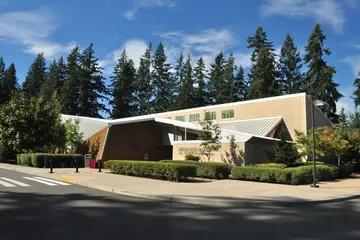
The Tulalip Tribes' Hibulb Cultural Center. Joe Mabel, CC BY-SA 3.0
_(2).jpg)
Forest, stumps and chickens
-
1889
A homestead in the forest
Scottish stonemason Duncan Hunter filed a claim on 80 acres of forest and became the first settler to stay in what is now Lynnwood.
-
1900 to 1920
The big trees come down
Most of the land that became Lynnwood was logged, and the forest turned into stump ranches. The biggest landowner was the Puget Mill Company.
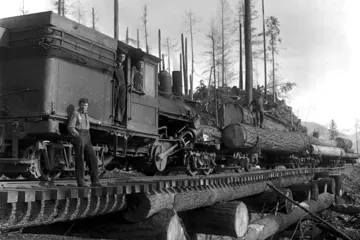
Hauling logs in Snohomish County, about 1913. Lee Pickett, public domain -
1910
The Interurban arrives
The electric railway between Seattle and Everett was finished, with stops in the stump country at Alderwood, Intermanor, Manordale and Martha Lake.
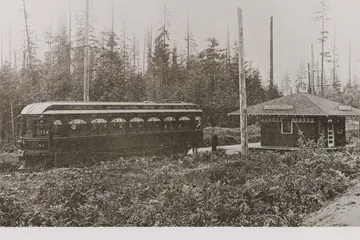
A Seattle-Everett car at Beverly Park station, 1910. Seattle Public Library, public domain -
1917
Alderwood Manor
The Puget Mill Company cut its logged land into five- to ten-acre "ranchettes" called Alderwood Manor, and built a demonstration farm to teach newcomers to raise crops and chickens.
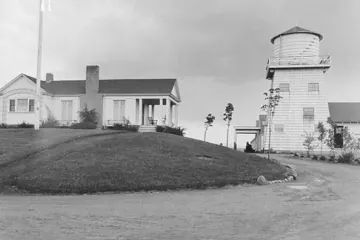
The farm's cottage and water tower, about 1925. Both still stand, in Heritage Park. UW Libraries, public domain -
1919
The Wickers Building
Alderwood Manor's first general store and post office opened. It stands today in Heritage Park.
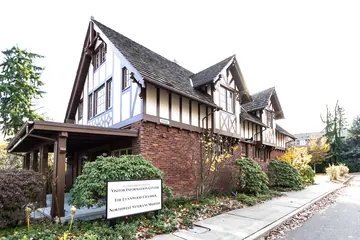
The Wickers Building in Heritage Park. Cindy Shebley, CC BY 2.0 -
1917 to 1922
200,000 hens
Alderwood Manor grew from 22 people to 1,463, and 200,000 hens. In the 1920s only Petaluma, California, produced more eggs.
.jpeg)

.jpg)
.jpg)
The road, the name, the city
-
1927
Highway 99
In the fall, the concrete Pacific Highway opened between Seattle and Everett, about a mile west of the Interurban. Businesses grew up where it crossed Alderwood Road, a spot known as the Crossroads.
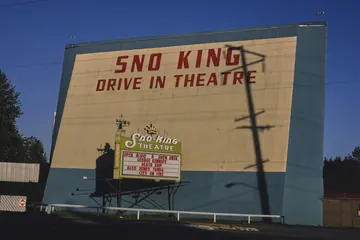
Later on the same road: the Sno-King Drive-in, 1980. John Margolies, Library of Congress, public domain -
The 1930s
A dime a dozen
In the Great Depression egg prices fell from a dollar a dozen to a dime, and the chicken farms struggled.
-
1937
A name for Lynn
At the end of the year Seattle realtor Karl O'Beirn platted land along Highway 99 and named it Lynnwood, after his wife, Lynn.
-
1939
The last Interurban
The Interurban stopped running, as cars and Highway 99 took its riders.
-
After 1945
Everyone heads north
The region boomed. King County alone grew by some 225,000 people in the 1940s, and many of them looked north for a place to live.
-
April 1959
The City of Lynnwood
Lynnwood incorporated as a city, with about 6,000 people on three square miles.
-
3 February 1965
Interstate 5
The freeway between Everett and Seattle was finished, along the city's eastern edge. The traffic arrived on schedule.
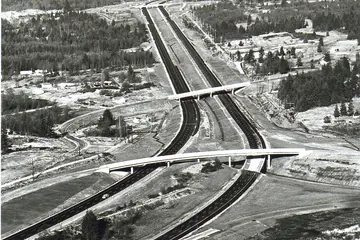
The new I-5 near Swamp Creek, 1967. Federal Highway Administration, public domain -
1967
A college
Edmonds Community College opened in September with 460 students, in an unfinished high school. Today it is Edmonds College, in Lynnwood.
-
1979
A mall on a homestead
Alderwood Mall opened in September, east of I-5 on the old Morrice homestead.

The line comes back
-
2004
Heritage Park
The park opened, gathering Alderwood Manor buildings rescued from the 1997 freeway interchange work. Interurban Car No. 55 lives there too.
-
30 August 2024
Light rail
Trains reached Lynnwood City Center, 85 years after the last Interurban car. In 2026 a second line began running from here to Bellevue and Redmond, and a new station opened at Pinehurst.
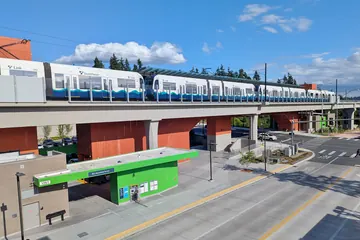
A train at Mountlake Terrace, one stop south, in 2025. SounderBruce, CC BY-SA 4.0

Every date here is checked against its source. See the sources